K-ETA 2026: Exemption Runs Until Dec 31, 2026 (Fee, e-Arrival Card & 2027 Outlook)
Updated October 2026

Ask most travel forums about entering South Korea and you'll get outdated advice — plenty still insist every visa-free visitor has to apply for a K-ETA online before flying in. That hasn't been fully true since 2023, and it's staying that way through the end of 2026: if you're a citizen of one of 22+ exempt countries — the US, UK, Canada, Australia, Japan, and most of the EU among them — you can skip the K-ETA step entirely and go straight to a standard arrival card.
The confusing part isn't the concept, it's the details: the exact list of exempt countries, and what still hasn't changed (your visa-free stay limit is untouched), trip up more travelers than you'd expect. Here's the full, current picture, straight from Korea's Ministry of Justice and embassy notices, plus what to do if your country isn't on the list.
Already sorted on entry requirements? Getting around once you land is the next hurdle — check out our Korea Taxi Survival Guide on the Seoul Cut shop →

Incheon International Airport arrivals hall. (Public domain, Wikimedia Commons)
What Is K-ETA, Again?
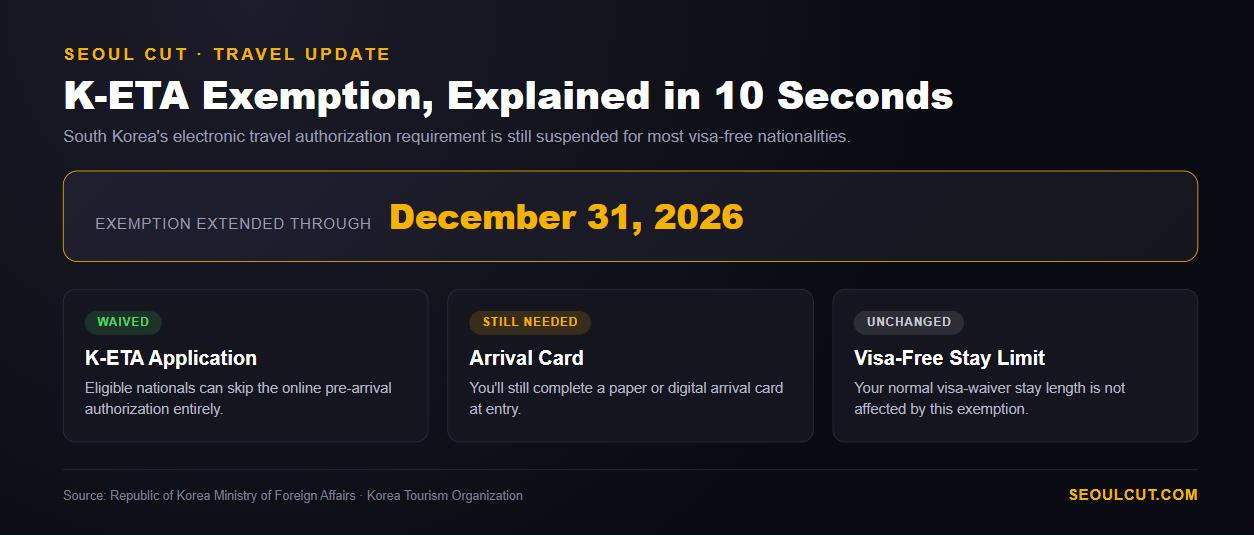
K-ETA (Korea Electronic Travel Authorization) is South Korea's version of the US ESTA — a pre-arrival online screening that visa-free travelers are normally required to complete before flying in. Since 2023, however, the Korean Ministry of Justice has repeatedly suspended this requirement for most visa-waiver nationalities as part of a tourism-recovery push tied to "Visit Korea Year." The current exemption, extended in December 2025, runs to December 31, 2026.
The Update: Exemption Extended Through December 31, 2026
According to official notices published by South Korea's Ministry of Foreign Affairs (via multiple embassy channels, including the Embassy of Korea to Belgium and the Embassy of Korea to Austria), the Ministry of Justice has extended the temporary K-ETA exemption for one additional year:
New exemption window: January 1, 2026 – December 31, 2026 (Korea Standard Time)
This is not a new policy — it's a continuation of the exemption that has been in effect (and renewed annually) since April 2023. The official Korea Tourism Organization portal, VisitKorea.or.kr, confirms the same window and clarifies the key mechanic: the exemption applies to nationals of countries or regions already eligible for Korea's visa-waiver program — it removes the K-ETA step, not the underlying visa-free eligibility itself.
Who's On the Exempt List?
Per the Ministry of Justice's official announcement (cross-referenced across embassy notices from Belgium, Austria, Canada, the Netherlands, Sweden, and the Atlanta and New York consulates), the following 22 countries and regions are covered:
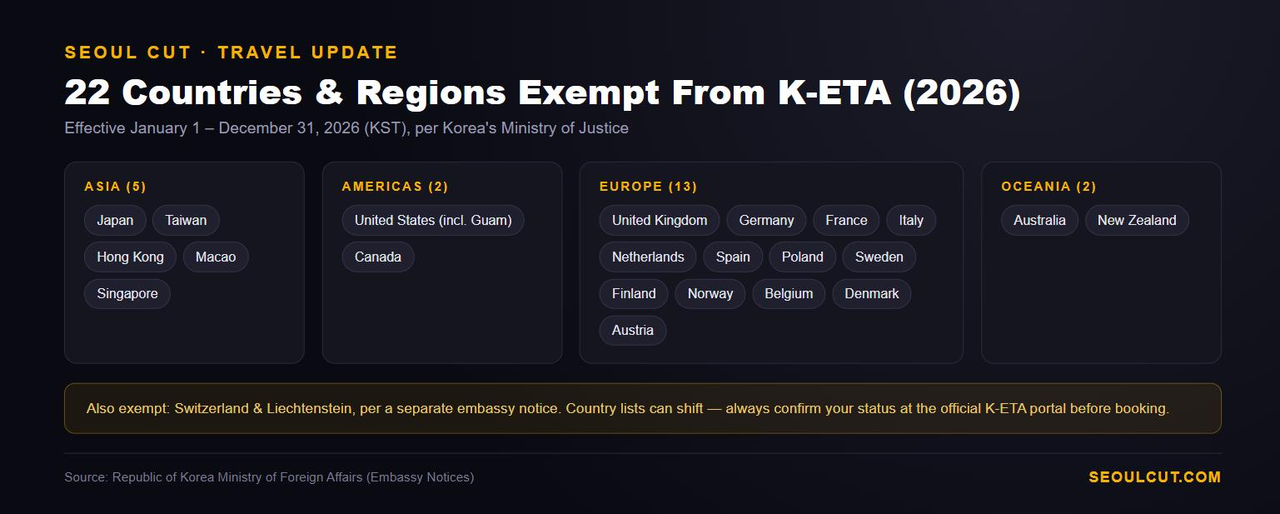
- Asia (5): Japan, Taiwan, Hong Kong, Macao, Singapore
- Americas (2): United States (including Guam), Canada
- Europe (13): United Kingdom, Germany, France, Italy, Netherlands, Spain, Poland, Sweden, Finland, Norway, Belgium, Denmark, Austria
- Oceania (2): Australia, New Zealand
One important note for readers in Switzerland and Liechtenstein: a separate official notice from the Embassy of Korea to Switzerland confirms both are also covered under the same exemption. Because exact country counts have varied slightly across embassy bulletins (22 vs. 23), we recommend citizens of any country not listed above double-check their status directly on the official K-ETA portal before booking, since this list is a government policy that can be adjusted mid-year.

Lotte World Tower, Jamsil — the tallest building in Seoul. Photo by Jongjin Lee (CC BY 3.0)
Does This Change How Long You Can Stay?
No. This is the part people misunderstand most often. The K-ETA exemption only removes the pre-arrival application step — it does not change your maximum visa-free stay length, which is set separately for each nationality under Korea's existing visa-waiver agreements (commonly up to 90 days, though this varies by country). If you were eligible for visa-free entry before this exemption, that eligibility and stay limit are unchanged. Always confirm your specific country's stay limit with your nearest Korean embassy or consulate before finalizing travel plans.
What This Means at the Airport
Clearing immigration is the straightforward part. The hour after it is what actually catches people out — our Incheon Airport luggage storage and transport guide covers where to leave your bags if you land before check-in, and how the AREX train, the limousine bus and a taxi compare on price and time.

Korea Immigration Service, Incheon International Airport. Photo by Vuong Tri Binh (CC BY-SA 4.0)
| Situation | What You Need To Do |
|---|---|
| Your country is on the exempt list | Skip K-ETA. Submit an arrival card instead — ideally the free online e-Arrival Card at e-arrivalcard.go.kr, up to 3 days before you land. |
| Your country is on the exempt list, but you want to skip the arrival card too | You may still voluntarily apply for a paid K-ETA (KRW 10,000 plus an online payment fee of roughly 3%, non-refundable). An approved K-ETA means you don't submit an arrival card. |
| Your country is not on the exempt list, but is visa-free eligible | You must have an approved K-ETA before boarding. Apply at k-eta.go.kr or the official K-ETA app. |
| You already hold a valid K-ETA from before this exemption | It remains valid until its original expiration date. No refund is issued for the exemption period. |
What Happens After December 31, 2026?
The exemption window ends on December 31, 2026 (KST). As of mid-October 2026, neither the official K-ETA portal nor the Ministry of Justice has announced an extension into 2027. Past extensions were all announced in late December (the 2026 one went up on k-eta.go.kr on December 23, 2025), so a decision could come at the last minute. If your trip starts on or after January 1, 2027, plan as if you'll need a K-ETA and check the portal's notices before you fly.
K-ETA Essentials: Fee, Validity, Processing Time
- Fee: KRW 10,000 per person (about US$7–8), plus an online payment processing fee of about 3%. It isn't refunded, even if you're refused.
- Validity: 3 years and usable for multiple entries. If your passport expires sooner, the K-ETA ends with the passport. Each stay is still capped at your country's visa-free period.
- Processing: usually 72 hours or less, but it can take longer. There is no paid fast-track.
- Timing: you must be approved before boarding your flight or ship.
- Age exemption: visa-free travelers aged 17 or under, or 65 or over, don't need a K-ETA.
How to Apply (If You Need To)
- Go to www.k-eta.go.kr or download the official K-ETA mobile app.
- Choose your nationality. If you're exempt, a "K-ETA Exempt" pop-up will appear.
- Enter your passport details, upload a photo and give your trip and accommodation information.
- Pay KRW 10,000 by card. VISA, Mastercard, JCB, AMEX, Diners, Discover, UnionPay and Alipay+ are accepted.
- Check your result on the portal and keep it with you when you travel.
e-Arrival Card vs. Q-CODE: Don't Mix Them Up
Since February 24, 2025, Korea's Ministry of Justice has run a free online e-Arrival Card at e-arrivalcard.go.kr. You can submit it from 3 days before arrival, and it lapses 72 hours after submission. Korean embassies describe it as the standard for entry from 2026. K-ETA holders don't need to submit one. It is a separate system from K-ETA.
Q-CODE (KDCA travel health) is a quarantine health declaration run by the Korea Disease Control and Prevention Agency. It is not an arrival card. It's only required if you've stayed in or passed through a designated quarantine-management area, or if you have symptoms such as fever or cough. That list is updated every quarter.
Disclosure: This post contains affiliate links. If you book through them, Seoul Cut may earn a small commission at no extra cost to you.
Beware of Fake K-ETA and e-Arrival Card Sites
Lookalike sites charge far more than the official fee. The Korean government has not appointed any agency to file K-ETA applications. The only official sites are k-eta.go.kr (plus the K-ETA app) and e-arrivalcard.go.kr, and the e-Arrival Card is always free. If an "arrival card" site asks for payment details, it is a scam (Korea Immigration Service, March 2026).
Frequently Asked Questions
Is K-ETA gone for good?
No. This is a temporary suspension that has been renewed each year since 2023, not a permanent change. The current window ends December 31, 2026, and as of October 2026 no extension into 2027 has been announced.
I'm exempt from K-ETA — do I need any paperwork at all?
Yes. You'll still need an arrival card. The online e-Arrival Card (free, at e-arrivalcard.go.kr) can be filed from 3 days before arrival and expires 72 hours after submission. Q-CODE is a separate health/quarantine declaration, not an arrival card. It's only needed if you've recently been in a designated quarantine-management area or have symptoms.
My country isn't listed — what do I do?
If your country is otherwise visa-free eligible for Korea, you'll need to apply for K-ETA in advance at the official portal, k-eta.go.kr. The official site says screening typically takes 72 hours or less but can take longer, with no expedited service. Korea's K-ETA notice recommends applying 1–2 months before departure.
Where can I double check this before I book my flight?
Always verify directly with the official K-ETA portal or your nearest Korean embassy/consulate — policy windows like this one are reviewed and renewed (or occasionally adjusted) on a rolling basis.
Sources
- Embassy of the Republic of Korea to the Kingdom of Belgium — Official Notice, K-ETA Temporary Exemption
- Embassy of the Republic of Korea in Austria — Official Notice, K-ETA Temporary Exemption Extension
- Embassy of the Republic of Korea to Switzerland & Liechtenstein — Official Notice
- Korea Tourism Organization (VisitKorea.or.kr) — Official Announcement
- Korea Consulate General, Atlanta & New York — Official Notices
- K-ETA official portal — Notice on Extension of K-ETA Temporary Exemption (Dec 23, 2025); application guide; fee guide
- Embassy of Korea to the Netherlands — K-ETA exemption extension notice (Jan 2026)
- e-Arrival Card official guide — e-arrivalcard.go.kr
- Korea Immigration Service — Beware of Fake e-Arrival Card Websites (Mar 2026)
- KDCA — Q-CODE information

Already planning your Korea trip? Once you land, getting around Seoul is its own learning curve — from taxi apps that actually work for foreigners to which ones to avoid. Check out our Korea Taxi Survival Guide on the Seoul Cut shop so you're not figuring it out on the sidewalk with jet lag.
Written by a Seoul-based global business owner. Follow more verified, no-fluff Korea travel guides at SeoulCut.com.
Written by Seoul Cut, a global trade professional with 20 years of experience across Europe & Asia. I share practical, zero-tourist-trap guides to Korea drawn from years of hosting international visitors.
Get complete Korea travel & guide resources with offline cheat sheets and exact fare estimates. Limited to the first 50 downloads! Use code SEOULCUT at checkout.
👉 Claim Your 20% OFF Guide - Code: SEOULCUT
